Learning among trees: why the natural environment of Sant Cugat and Collserola is the most powerful classroom for your children

Borja Vilaseca
Why the natural environment of Sant Cugat and Collserola is the most powerful classroom for your children
13:00
|
✦ TERRA'S PHILOSOPHY We are not part of the planet. We are the planet looking at itself. |
There is a question that many parents in Barcelona and Sant Cugat ask themselves at some point, Is my child happy at school? Desks lined up, screens, homework, exams. A chain of knowledge production that seems to ignore the most essential thing: that children are living beings, with enormous potential.
If you have ever felt that discomfort, this article is for you. Today we want to talk to you about something we carry in our DNA at Terra: the deep conviction that the natural environment is not a complement to learning. It is a fundamental part of it.
A few minutes away from Barcelona, among the unique green of Sant Cugat del Vallès, and with the Collserola Natural Park as a living horizon, Terra accompanies children from a place of belonging: the natural world is not something that is studied. It is something to be part of.
The disconnection that no one names but everyone feels
We live in cities designed for efficient adults. Asphalt, compressed schedules, artificial light and the omnipresence of screens have created an environment that, for many children, is fundamentally alien to their nature. It is no coincidence that childhood stress has steadily increased in recent years, nor that many children come home with energy that seems to be pent up under pressure.
What that energy is asking for is dirt underfoot, unfiltered air, insects to discover, cycles of nature to observe. What it is asking for is exactly what nature offers that the traditional education system rarely provides.
|
🌍 SCIENTIFIC EVIDENCE. Studies on biomes - sets of ecosystems defined by their climatic and biological characteristics - show that children who maintain regular contact with natural environments develop greater attention span, emotional regulation and systems thinking. These are not abstract data: they are the reflection of an evolutionary intelligence that childhood still carries intact. |
At Terra, we have chosen to start from this reality. Not from guilt, "I must take care of the planet because if I don't, something bad will happen" but from joyful responsibility: the conviction that when a child feels part of nature, he or she takes care of it in a natural way. First the bond is created, then responsibility is born as a natural expression of belonging and respect.
Sant Cugat and Collserola: an environment that teaches by just existing
The Terra school is located in one of the most privileged locations in the metropolitan area of Barcelona. Sant Cugat del Vallès is not only a well-connected municipality, 20 minutes from the city center; it is a place where the urban and the natural coexist in a way that few schools can offer.
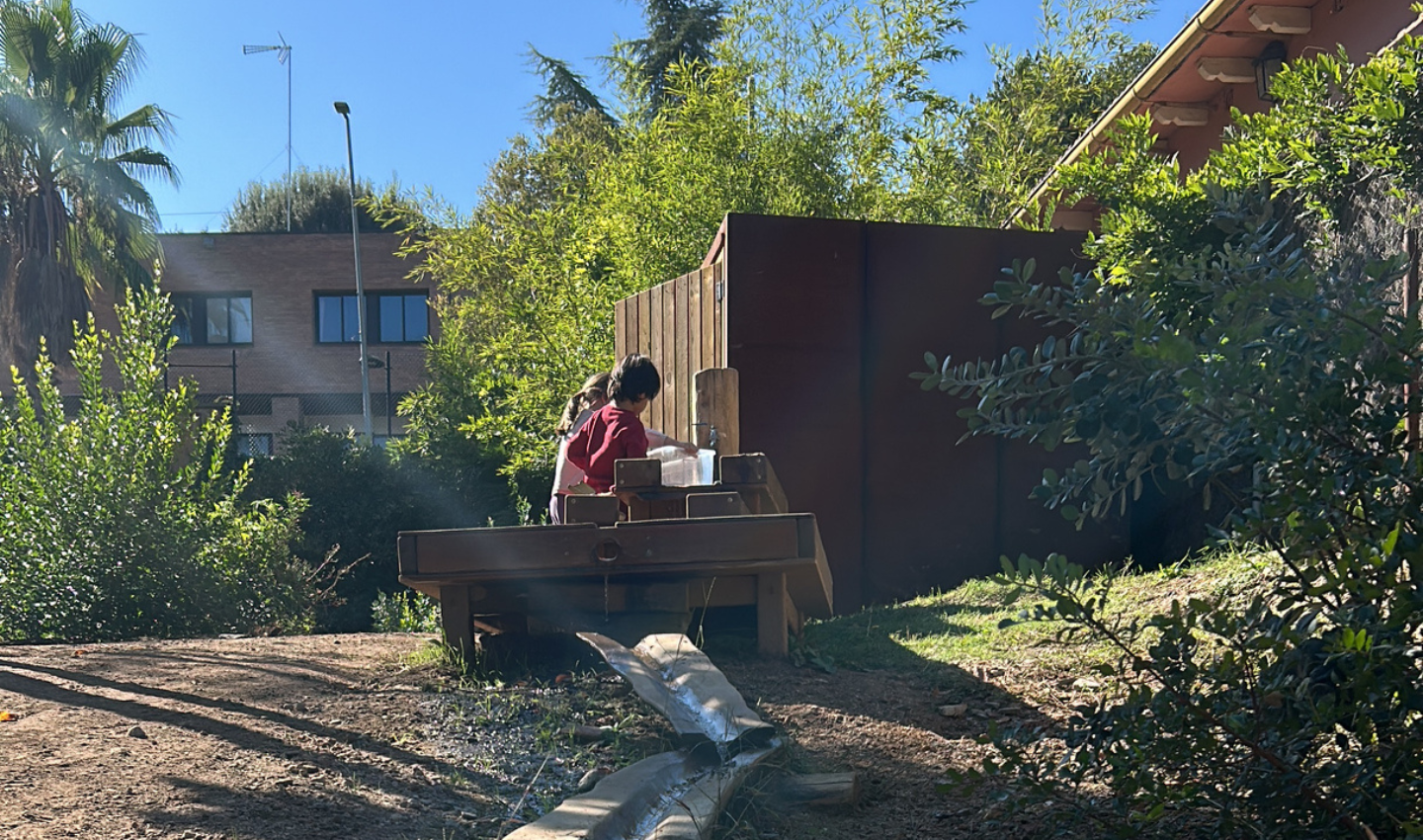
Our school space is surrounded by trees and gardens that change with the seasons. We have an active school garden, where children learn what it means to plant, wait, observe and harvest. And a naturalized playground designed with elements that invite free play, sensory discovery and genuine contact with the environment: earth, stones, water, wood.
|
OUR LIVING LEARNING SPACES - Terra School - Sant Cugat del Vallès The environments where Terra's children learn - Trees and gardens that change with the seasons - School garden with seasonal produce - Naturalized playground with natural materials and elements - Environments for observing local biodiversity - Collserola (8,000 ha of Mediterranean forest) as a permanent learning space - Environments prepared with natural light and ventilation |
Beyond the school itself, the Sierra de Collserola Natural Park, one of the largest metropolitan parks in Europe, with more than 8,000 hectares of Mediterranean forest, becomes a natural extension of our learning environments. Collserola is not a one-time excursion. It is a living biome to which Terra's children feel they belong.
The ecological dimension: much more than 'taking care of the environment'.
At Terra, the relationship with nature is part of the 11 dimensions of conscious education: a pedagogy that ensures that each child grows in an integral way, inwardly and outwardly. The ecological dimension is one of these essential dimensions, and we want to explain what it means from our point of view.
We are not talking about memorizing a list of sustainable habits. Nor are we talking about repeating the names of endangered species. We are talking about something much deeper: accompanying each child to understand that they are not spectators of the planet, but a living part of it.
THE SIX PRINCIPLES THAT GUIDE OUR CONNECTION WITH NATURE |
- Reconnecting with the Earth as a link, not as content Nature is not a subject. It is a relationship. We accompany children to feel part of the living world before asking them to study it.
- Joyful responsibility, not guilt We do not accompany ecology from fear or obligation. We cultivate care from love and a sense of belonging: first I feel part of nature, so I take care of it.
- We are part of a fabric, not spectators . Every action, although local and close, has a global repercussion. Children learn to recognize their place within the biome to which they belong and to act with awareness.
- Ecology as daily spirituality Observing the water cycle, sowing a seed, waiting for the fruit. These are everyday acts that connect with something greater than oneself. We call it full presence in the natural world.
- The planet looking at itself 'We are not part of the planet. We are the planet looking at itself.' This gaze transforms the relationship with the environment from top to bottom.
- Conscious management of resources The ecological dimension connects with the financial dimension: learning to manage the planet's resources consciously is also learning to live sustainably and responsibly.
How is this lived out in Terra's day-to-day business?
Families who know us know that at Terra we don't stop at words. The ecological dimension is practiced, touched and smelled. And it has a concrete and daily presence in the children's lives.
The garden: learning that springs from the land
Our school garden is not a decorative space. It is a learning companion as real as any prepared environment inside the building. In it, children discover sustainable cultivation techniques, learn what a seasonal plant means, observe the cycles of growth with their own eyes and hands, and develop the patience and attentiveness that only nature knows how to teach.
|
🌱 VOICE OF EARTH. When a child plants a seed and waits for its sprout, he or she is learning biology. But he or she is also learning trust, presence and care. Three life skills that no book can convey as effectively. |
The Naturalized Playground: Play as Ecological Intelligence
We have designed our outdoor space so that free play is also an act of connection with the environment. Earth, water, stones, plants, wood. Natural materials that invite you to build, explore, feel. Terra's outdoor space is not a standardized playground: it is a living environment where learning and playing are inseparable.
Children who play in contact with nature develop a greater attention span, greater creativity and a sensitivity to the environment that will be an asset throughout their lives.
Sustainable projects that connect with the real world
The ecological dimension in Terra is also articulated through proposals that allow us to understand, from experience, that we are all part of interconnected systems, and that our actions have a real impact on the environment. We carry out permaculture projects, circular economy, observation of local biodiversity, and design solutions for the immediate environment.
We are not looking for children to accumulate knowledge about ecology. We want them to acquire an increasing level of awareness and responsibility, understanding that their actions have a real impact.
Educating to belong: learning to live in the real world
At Terra, the ecological dimension is not understood as an isolated concept, but as a way of learning to inhabit the world with awareness. When a child understands that resources are not infinite, that every choice has an impact and that being part of an environment also implies taking care of it, he or she begins to develop something much deeper than sustainable habits: a way of being in life.
That is why the ecological dimension connects naturally with other dimensions such as the financial one. Learning to manage the planet's resources with respect and care is, at the same time, learning to live sustainably, responsibly and coherently with our own resources and the reality around us. Not from limitation, but from understanding.
This is, perhaps, the quietest and most lasting learning that Terra can offer. Not a list of correct behaviors, but an identity: that of a human being who understands how the world he inhabits works, who makes decisions with awareness and who knows that taking care of what he has, be it a forest, an object, or his own time, is an essential part of living consciously and responsibly.
|
Why is learning in contact with nature beneficial for children? |
|
Nature stimulates all the senses, helps regulate the nervous system, encourages innate curiosity, improves the physical, emotional, cognitive and social development of children, and promotes ecological responsibility. At Terra, the natural environment of Sant Cugat and Collserola is another learning space where children connect with knowledge through direct experience.
|
|
What is the ecological dimension of Terra's conscious education? |
|
It is one of the 11 dimensions of conscious education. It seeks to make each child understand that we are not spectators of the planet, but part of it. We work in the school garden, the naturalized playground with monthly outings to the environment of Collserola and other natural areas, and with educational proposals that promote learning and the link with the environment.
|
|
What is so special about the environment of the Terra school in Sant Cugat? |
|
Trees and gardens that change with the seasons, active school garden, naturalized playground and access to the Collserola Natural Park: more than 8,000 hectares of Mediterranean forest as a permanent classroom.
|
|
How does Terra work on sustainability without transmitting guilt or fear? |
|
Through a 'joyful responsibility': first we accompany the children to feel part of nature. That bond becomes the natural engine of care, without obligation or fear. Because when a child feels part of the Earth, water, plants and animals, care ceases to be experienced as an obligation, and becomes a natural expression of belonging and respect.
|
|
Is Terra a nature school or forest school? |
|
Terra is a school that promotes experiential learning and the link with the environment and nature. The school garden, the naturalized playground and the environment of Sant Cugat and Collserola are an active part of the school's daily life. The ecological dimension is one of the 11 dimensions of conscious education, but not the only one. In addition to the link with nature, Terra promotes self-knowledge, social, artistic and scientific dimensions, among others.
|
|
📍 TERRA ESCOLA - SANT CUGAT DEL VALLÈS Terra is located in Sant Cugat del Vallès, 20 minutes from the center of Barcelona, surrounded by the privileged environment of the Collserola Natural Park. A place where nature is not an excursion, but part of the daily fabric of the educational experience. |
|
TERRA - SANT CUGAT DEL VALLES Do you want your sons and daughters to flourish in an environment that respects them? At Terra we accompany children from a place of belonging, curiosity and love for the living world. If anything you've read today resonates with you, we'd love to meet you.
|